
Former CBS News president Richard Salant (1961 - 64 and 1966 - 79) explained the major media's role: "Our job is to give people not what they want, but what we decide they ought to have." ...and to this very day most Americans haven't noticed they're being brained washed! ~ N. Hooben
Sunday, July 25, 2010


Saturday, July 24, 2010
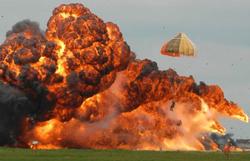
Firery Crash...pilot has close call (spectacular pictures) Updated with video!
See video at bottom of page.
Fighter jet crashes in Lethbridge, pilot ejects safely

Fighter jet crashes in Lethbridge, pilot ejects safely

A CF-18 fighter jet crashed on Friday in Lethbridge as it prepared for an airshow in Alberta, but the pilot managed to eject before the plane slammed into the ground.
Despite the crash at the Lethbridge airport, the Alberta International AirShow will go ahead as planned this weekend.
Canadian Air Force pilot Captain Brian Bews ejected safely from his CF-18 fighter jet just moments before it crashed during a practice flight on the eve of the annual event.
Despite the crash at the Lethbridge airport, the Alberta International AirShow will go ahead as planned this weekend.
Canadian Air Force pilot Captain Brian Bews ejected safely from his CF-18 fighter jet just moments before it crashed during a practice
 flight on the eve of the annual event.
Bews escaped serious injury in the crash, which occurred during the noon-hour while he was attempting a slow-speed pass over the airport. After ejecting, he narrowly missed being hit by the plane as it plunged to the ground and exploded in flames near
the junction of two runways, according to witnesses.
The Department of National Defence is handling the investigation into the cause of the crash. Transport Canada officials also arrived Friday to monitor the situation but are leaving the investigation in the hands of the military.
“We planned for this. We know this kind of thing can happen. The military said they would support us, and we thought we couldn’t let our community down,” said Kathy Wallocha, past president of the air show.
Image above courtesy Ian Martens/Lethbridge Herald/CBC News (more).
Friday, July 23, 2010
Comment of the day.
Pejman Yousefzadeh Attorney and blogger :
Nancy Pelosi promised us "the most ethical Congress in history," during the 2006 midterm elections. The reality is quite different. Every effort was made by the House Democratic leadership to save Charlie Rangel, despite the mountain of evidence showing that he violated ethical rules. The House Democrats were only willing to cut Rangel loose when he became too much of an embarrassment to them.
Ethical people usually do not have to be coerced into behaving ethically. However, in Rangel's case, no amount of coercion got him to be ethical, and it took the political equivalent of moving heaven and earth to get the House Democratic leadership to denounce Rangel's behavior. If this is the Democratic leadership's idea of good government, then I would hate to see bad government in action.
Source: Politico.com
Thursday, July 22, 2010
John F. Kennedy's Secret Society Speech
The speech was given in 1961 but it may as well be 2010 or anywhere in between. President Kennedy was addressing the American Newspaper Publishers Association or what we would refer to today as the mainstream media (MSM). So the one-sided media has been around for some time or as Kennedy phrases it, "...the so-called one party press." One sometimes wonders how and why the MSM appears to be at times so anti-American and so narrowly focused. Well that would lead us into another story that I don't want to get into here but suffice it to say the uni-vision direction of the MSM had its beginnings with the banking cartels (i.e. JP Morgan et al). They selected or rather purchased the most influential newspapers in the United States to control what the general public consumed as news...this was verified in the Congressional Record of 1917. You might ask, "Why would they do that?" The answer to that is simply, "control". The money people (lets call them the politic elite) want to control the entire world and run it as they see fit (you and I are just pawns or slaves in their whimsical plans).
To accomplish this control and/or takeover of society there would have to be a sophisticated network of like minded people operating in a very clandestine manner. President Kennedy recognized that such people existed (by the way, President Eisenhower also recognized that people behind the scenes of government in fact were the controllers of government) and here he refers to such secrecy as, "repugnant". Well we shall see that what is happening in our dying days as a country is a direct result of the the repugnant people that desire some kind of new world order that we the people did not order. Who are these people? Take a good look at this video and many of the scoundrels will be revealed...and don't worry about them being Democrat or Republican because that's one area they have had almost complete control over us for a number of years. Who else wrote the FEC rules? That's right, it was both parties...they want to limit your choices and they have pretty much succeded in that area. ~ Norman E. Hooben
ps: if you want to read along with President Kennedy the complete text is below the video.
President John F. Kennedy’s Secret Society Speech
I appreciate very much your generous invitation to be here tonight.
You bear heavy responsibilities these days and an article I read some time ago reminded me of how particularly heavily the burdens of present day events bear upon your profession.
You may remember that in 1851 the New York Herald Tribune under the sponsorship and publishing of Horace Greeley, employed as its London correspondent an obscure journalist by the name of Karl Marx.
We are told that foreign correspondent Marx, stone broke, and with a family ill and undernourished, constantly appealed to Greeley and managing editor Charles Dana for an increase in his munificent salary of $5 per installment, a salary which he and Engels ungratefully labeled as the "lousiest petty bourgeois cheating."
But when all his financial appeals were refused, Marx looked around for other means of livelihood and fame, eventually terminating his relationship with the Tribune and devoting his talents full time to the cause that would bequeath the world the seeds of Leninism, Stalinism, revolution and the cold war.
If only this capitalistic New York newspaper had treated him more kindly; if only Marx had remained a foreign correspondent, history might have been different. And I hope all publishers will bear this lesson in mind the next time they receive a poverty-stricken appeal for a small increase in the expense account from an obscure newspaper man.
I have selected as the title of my remarks tonight "The President and the Press." Some may suggest that this would be more naturally worded "The President Versus the Press." But those are not my sentiments tonight.
It is true, however, that when a well-known diplomat from another country demanded recently that our State Department repudiate certain newspaper attacks on his colleague it was unnecessary for us to reply that this Administration was not responsible for the press, for the press had already made it clear that it was not responsible for this Administration.
Nevertheless, my purpose here tonight is not to deliver the usual assault on the so-called one party press. On the contrary, in recent months I have rarely heard any complaints about political bias in the press except from a few Republicans. Nor is it my purpose tonight to discuss or defend the televising of Presidential press conferences. I think it is highly beneficial to have some 20,000,000 Americans regularly sit in on these conferences to observe, if I may say so, the incisive, the intelligent and the courteous qualities displayed by your Washington correspondents.
Nor, finally, are these remarks intended to examine the proper degree of privacy which the press should allow to any President and his family.
If in the last few months your White House reporters and photographers have been attending church services with regularity, that has surely done them no harm.
On the other hand, I realize that your staff and wire service photographers may be complaining that they do not enjoy the same green privileges at the local golf courses that they once did.
It is true that my predecessor did not object as I do to pictures of one's golfing skill in action. But neither on the other hand did he ever bean a Secret Service man.
My topic tonight is a more sober one of concern to publishers as well as editors.
I want to talk about our common responsibilities in the face of a common danger. The events of recent weeks may have helped to illuminate that challenge for some; but the dimensions of its threat have loomed large on the horizon for many years. Whatever our hopes may be for the future--for reducing this threat or living with it--there is no escaping either the gravity or the totality of its challenge to our survival and to our security--a challenge that confronts us in unaccustomed ways in every sphere of human activity.
This deadly challenge imposes upon our society two requirements of direct concern both to the press and to the President--two requirements that may seem almost contradictory in tone, but which must be reconciled and fulfilled if we are to meet this national peril. I refer, first, to the need for a far greater public information; and, second, to the need for far greater official secrecy.
But I do ask every publisher, every editor, and every newsman in the nation to reexamine his own standards, and to recognize the nature of our country's peril. In time of war, the government and the press have customarily joined in an effort based largely on self-discipline, to prevent unauthorized disclosures to the enemy. In time of "clear and present danger," the courts have held that even the privileged rights of the First Amendment must yield to the public's need for national security.
Today no war has been declared--and however fierce the struggle may be, it may never be declared in the traditional fashion. Our way of life is under attack. Those who make themselves our enemy are advancing around the globe. The survival of our friends is in danger. And yet no war has been declared, no borders have been crossed by marching troops, no missiles have been fired.
If the press is awaiting a declaration of war before it imposes the self-discipline of combat conditions, then I can only say that no war ever posed a greater threat to our security. If you are awaiting a finding of "clear and present danger," then I can only say that the danger has never been more clear and its presence has never been more imminent.
It requires a change in outlook, a change in tactics, a change in missions--by the government, by the people, by every businessman or labor leader, and by every newspaper. For we are opposed around the world by a monolithic and ruthless conspiracy that relies primarily on covert means for expanding its sphere of influence--on infiltration instead of invasion, on subversion instead of elections, on intimidation instead of free choice, on guerrillas by night instead of armies by day. It is a system which has conscripted vast human and material resources into the building of a tightly knit, highly efficient machine that combines military, diplomatic, intelligence, economic, scientific and political operations.
Its preparations are concealed, not published. Its mistakes are buried, not headlined. Its dissenters are silenced, not praised. No expenditure is questioned, no rumor is printed, no secret is revealed. It conducts the Cold War, in short, with a war-time discipline no democracy would ever hope or wish to match.
Nevertheless, every democracy recognizes the necessary restraints of national security--and the question remains whether those restraints need to be more strictly observed if we are to oppose this kind of attack as well as outright invasion.
For the facts of the matter are that this nation's foes have openly boasted of acquiring through our newspapers information they would otherwise hire agents to acquire through theft, bribery or espionage; that details of this nation's covert preparations to counter the enemy's covert operations have been available to every newspaper reader, friend and foe alike; that the size, the strength, the location and the nature of our forces and weapons, and our plans and strategy for their use, have all been pinpointed in the press and other news media to a degree sufficient to satisfy any foreign power; and that, in at least in one case, the publication of details concerning a secret mechanism whereby satellites were followed required its alteration at the expense of considerable time and money.
The newspapers which printed these stories were loyal, patriotic, responsible and well-meaning. Had we been engaged in open warfare, they undoubtedly would not have published such items. But in the absence of open warfare, they recognized only the tests of journalism and not the tests of national security. And my question tonight is whether additional tests should not now be adopted.
The question is for you alone to answer. No public official should answer it for you. No governmental plan should impose its restraints against your will. But I would be failing in my duty to the nation, in considering all of the responsibilities that we now bear and all of the means at hand to meet those responsibilities, if I did not commend this problem to your attention, and urge its thoughtful consideration.
On many earlier occasions, I have said--and your newspapers have constantly said--that these are times that appeal to every citizen's sense of sacrifice and self-discipline. They call out to every citizen to weigh his rights and comforts against his obligations to the common good. I cannot now believe that those citizens who serve in the newspaper business consider themselves exempt from that appeal.
I have no intention of establishing a new Office of War Information to govern the flow of news. I am not suggesting any new forms of censorship or any new types of security classifications. I have no easy answer to the dilemma that I have posed, and would not seek to impose it if I had one. But I am asking the members of the newspaper profession and the industry in this country to reexamine their own responsibilities, to consider the degree and the nature of the present danger, and to heed the duty of self-restraint which that danger imposes upon us all.
Every newspaper now asks itself, with respect to every story: "Is it news?" All I suggest is that you add the question: "Is it in the interest of the national security?" And I hope that every group in America--unions and businessmen and public officials at every level-- will ask the same question of their endeavors, and subject their actions to the same exacting tests.
And should the press of America consider and recommend the voluntary assumption of specific new steps or machinery, I can assure you that we will cooperate whole-heartedly with those recommendations.
Perhaps there will be no recommendations. Perhaps there is no answer to the dilemma faced by a free and open society in a cold and secret war. In times of peace, any discussion of this subject, and any action that results, are both painful and without precedent. But this is a time of peace and peril which knows no precedent in history.
No President should fear public scrutiny of his program. For from that scrutiny comes understanding; and from that understanding comes support or opposition. And both are necessary. I am not asking your newspapers to support the Administration, but I am asking your help in the tremendous task of informing and alerting the American people. For I have complete confidence in the response and dedication of our citizens whenever they are fully informed.
I not only could not stifle controversy among your readers--I welcome it. This Administration intends to be candid about its errors; for as a wise man once said: "An error does not become a mistake until you refuse to correct it." We intend to accept full responsibility for our errors; and we expect you to point them out when we miss them.
Without debate, without criticism, no Administration and no country can succeed--and no republic can survive. That is why the Athenian lawmaker Solon decreed it a crime for any citizen to shrink from controversy. And that is why our press was protected by the First Amendment-- the only business in America specifically protected by the Constitution- -not primarily to amuse and entertain, not to emphasize the trivial and the sentimental, not to simply "give the public what it wants"--but to inform, to arouse, to reflect, to state our dangers and our opportunities, to indicate our crises and our choices, to lead, mold, educate and sometimes even anger public opinion.
This means greater coverage and analysis of international news--for it is no longer far away and foreign but close at hand and local. It means greater attention to improved understanding of the news as well as improved transmission. And it means, finally, that government at all levels, must meet its obligation to provide you with the fullest possible information outside the narrowest limits of national security--and we intend to do it.
And so it is to the printing press--to the recorder of man's deeds, the keeper of his conscience, the courier of his news--that we look for strength and assistance, confident that with your help man will be what he was born to be: free and independent.
To accomplish this control and/or takeover of society there would have to be a sophisticated network of like minded people operating in a very clandestine manner. President Kennedy recognized that such people existed (by the way, President Eisenhower also recognized that people behind the scenes of government in fact were the controllers of government) and here he refers to such secrecy as, "repugnant". Well we shall see that what is happening in our dying days as a country is a direct result of the the repugnant people that desire some kind of new world order that we the people did not order. Who are these people? Take a good look at this video and many of the scoundrels will be revealed...and don't worry about them being Democrat or Republican because that's one area they have had almost complete control over us for a number of years. Who else wrote the FEC rules? That's right, it was both parties...they want to limit your choices and they have pretty much succeded in that area. ~ Norman E. Hooben
ps: if you want to read along with President Kennedy the complete text is below the video.
The President and the Press: Address before the American Newspaper Publishers Association
President John F. Kennedy
Waldorf-Astoria Hotel
New York City, April 27, 1961
Mr. Chairman, ladies and gentlemen:Waldorf-Astoria Hotel
New York City, April 27, 1961
I appreciate very much your generous invitation to be here tonight.
You bear heavy responsibilities these days and an article I read some time ago reminded me of how particularly heavily the burdens of present day events bear upon your profession.
You may remember that in 1851 the New York Herald Tribune under the sponsorship and publishing of Horace Greeley, employed as its London correspondent an obscure journalist by the name of Karl Marx.
We are told that foreign correspondent Marx, stone broke, and with a family ill and undernourished, constantly appealed to Greeley and managing editor Charles Dana for an increase in his munificent salary of $5 per installment, a salary which he and Engels ungratefully labeled as the "lousiest petty bourgeois cheating."
But when all his financial appeals were refused, Marx looked around for other means of livelihood and fame, eventually terminating his relationship with the Tribune and devoting his talents full time to the cause that would bequeath the world the seeds of Leninism, Stalinism, revolution and the cold war.
If only this capitalistic New York newspaper had treated him more kindly; if only Marx had remained a foreign correspondent, history might have been different. And I hope all publishers will bear this lesson in mind the next time they receive a poverty-stricken appeal for a small increase in the expense account from an obscure newspaper man.
I have selected as the title of my remarks tonight "The President and the Press." Some may suggest that this would be more naturally worded "The President Versus the Press." But those are not my sentiments tonight.
It is true, however, that when a well-known diplomat from another country demanded recently that our State Department repudiate certain newspaper attacks on his colleague it was unnecessary for us to reply that this Administration was not responsible for the press, for the press had already made it clear that it was not responsible for this Administration.
Nevertheless, my purpose here tonight is not to deliver the usual assault on the so-called one party press. On the contrary, in recent months I have rarely heard any complaints about political bias in the press except from a few Republicans. Nor is it my purpose tonight to discuss or defend the televising of Presidential press conferences. I think it is highly beneficial to have some 20,000,000 Americans regularly sit in on these conferences to observe, if I may say so, the incisive, the intelligent and the courteous qualities displayed by your Washington correspondents.
Nor, finally, are these remarks intended to examine the proper degree of privacy which the press should allow to any President and his family.
If in the last few months your White House reporters and photographers have been attending church services with regularity, that has surely done them no harm.
On the other hand, I realize that your staff and wire service photographers may be complaining that they do not enjoy the same green privileges at the local golf courses that they once did.
It is true that my predecessor did not object as I do to pictures of one's golfing skill in action. But neither on the other hand did he ever bean a Secret Service man.
My topic tonight is a more sober one of concern to publishers as well as editors.
I want to talk about our common responsibilities in the face of a common danger. The events of recent weeks may have helped to illuminate that challenge for some; but the dimensions of its threat have loomed large on the horizon for many years. Whatever our hopes may be for the future--for reducing this threat or living with it--there is no escaping either the gravity or the totality of its challenge to our survival and to our security--a challenge that confronts us in unaccustomed ways in every sphere of human activity.
This deadly challenge imposes upon our society two requirements of direct concern both to the press and to the President--two requirements that may seem almost contradictory in tone, but which must be reconciled and fulfilled if we are to meet this national peril. I refer, first, to the need for a far greater public information; and, second, to the need for far greater official secrecy.
I
The very word "secrecy" is repugnant in a free and open society; and we are as a people inherently and historically opposed to secret societies, to secret oaths and to secret proceedings. We decided long ago that the dangers of excessive and unwarranted concealment of pertinent facts far outweighed the dangers which are cited to justify it. Even today, there is little value in opposing the threat of a closed society by imitating its arbitrary restrictions. Even today, there is little value in insuring the survival of our nation if our traditions do not survive with it. And there is very grave danger that an announced need for increased security will be seized upon by those anxious to expand its meaning to the very limits of official censorship and concealment. That I do not intend to permit to the extent that it is in my control. And no official of my Administration, whether his rank is high or low, civilian or military, should interpret my words here tonight as an excuse to censor the news, to stifle dissent, to cover up our mistakes or to withhold from the press and the public the facts they deserve to know.But I do ask every publisher, every editor, and every newsman in the nation to reexamine his own standards, and to recognize the nature of our country's peril. In time of war, the government and the press have customarily joined in an effort based largely on self-discipline, to prevent unauthorized disclosures to the enemy. In time of "clear and present danger," the courts have held that even the privileged rights of the First Amendment must yield to the public's need for national security.
Today no war has been declared--and however fierce the struggle may be, it may never be declared in the traditional fashion. Our way of life is under attack. Those who make themselves our enemy are advancing around the globe. The survival of our friends is in danger. And yet no war has been declared, no borders have been crossed by marching troops, no missiles have been fired.
If the press is awaiting a declaration of war before it imposes the self-discipline of combat conditions, then I can only say that no war ever posed a greater threat to our security. If you are awaiting a finding of "clear and present danger," then I can only say that the danger has never been more clear and its presence has never been more imminent.
It requires a change in outlook, a change in tactics, a change in missions--by the government, by the people, by every businessman or labor leader, and by every newspaper. For we are opposed around the world by a monolithic and ruthless conspiracy that relies primarily on covert means for expanding its sphere of influence--on infiltration instead of invasion, on subversion instead of elections, on intimidation instead of free choice, on guerrillas by night instead of armies by day. It is a system which has conscripted vast human and material resources into the building of a tightly knit, highly efficient machine that combines military, diplomatic, intelligence, economic, scientific and political operations.
Its preparations are concealed, not published. Its mistakes are buried, not headlined. Its dissenters are silenced, not praised. No expenditure is questioned, no rumor is printed, no secret is revealed. It conducts the Cold War, in short, with a war-time discipline no democracy would ever hope or wish to match.
Nevertheless, every democracy recognizes the necessary restraints of national security--and the question remains whether those restraints need to be more strictly observed if we are to oppose this kind of attack as well as outright invasion.
For the facts of the matter are that this nation's foes have openly boasted of acquiring through our newspapers information they would otherwise hire agents to acquire through theft, bribery or espionage; that details of this nation's covert preparations to counter the enemy's covert operations have been available to every newspaper reader, friend and foe alike; that the size, the strength, the location and the nature of our forces and weapons, and our plans and strategy for their use, have all been pinpointed in the press and other news media to a degree sufficient to satisfy any foreign power; and that, in at least in one case, the publication of details concerning a secret mechanism whereby satellites were followed required its alteration at the expense of considerable time and money.
The newspapers which printed these stories were loyal, patriotic, responsible and well-meaning. Had we been engaged in open warfare, they undoubtedly would not have published such items. But in the absence of open warfare, they recognized only the tests of journalism and not the tests of national security. And my question tonight is whether additional tests should not now be adopted.
The question is for you alone to answer. No public official should answer it for you. No governmental plan should impose its restraints against your will. But I would be failing in my duty to the nation, in considering all of the responsibilities that we now bear and all of the means at hand to meet those responsibilities, if I did not commend this problem to your attention, and urge its thoughtful consideration.
On many earlier occasions, I have said--and your newspapers have constantly said--that these are times that appeal to every citizen's sense of sacrifice and self-discipline. They call out to every citizen to weigh his rights and comforts against his obligations to the common good. I cannot now believe that those citizens who serve in the newspaper business consider themselves exempt from that appeal.
I have no intention of establishing a new Office of War Information to govern the flow of news. I am not suggesting any new forms of censorship or any new types of security classifications. I have no easy answer to the dilemma that I have posed, and would not seek to impose it if I had one. But I am asking the members of the newspaper profession and the industry in this country to reexamine their own responsibilities, to consider the degree and the nature of the present danger, and to heed the duty of self-restraint which that danger imposes upon us all.
Every newspaper now asks itself, with respect to every story: "Is it news?" All I suggest is that you add the question: "Is it in the interest of the national security?" And I hope that every group in America--unions and businessmen and public officials at every level-- will ask the same question of their endeavors, and subject their actions to the same exacting tests.
And should the press of America consider and recommend the voluntary assumption of specific new steps or machinery, I can assure you that we will cooperate whole-heartedly with those recommendations.
Perhaps there will be no recommendations. Perhaps there is no answer to the dilemma faced by a free and open society in a cold and secret war. In times of peace, any discussion of this subject, and any action that results, are both painful and without precedent. But this is a time of peace and peril which knows no precedent in history.
II
It is the unprecedented nature of this challenge that also gives rise to your second obligation--an obligation which I share. And that is our obligation to inform and alert the American people--to make certain that they possess all the facts that they need, and understand them as well--the perils, the prospects, the purposes of our program and the choices that we face.No President should fear public scrutiny of his program. For from that scrutiny comes understanding; and from that understanding comes support or opposition. And both are necessary. I am not asking your newspapers to support the Administration, but I am asking your help in the tremendous task of informing and alerting the American people. For I have complete confidence in the response and dedication of our citizens whenever they are fully informed.
I not only could not stifle controversy among your readers--I welcome it. This Administration intends to be candid about its errors; for as a wise man once said: "An error does not become a mistake until you refuse to correct it." We intend to accept full responsibility for our errors; and we expect you to point them out when we miss them.
Without debate, without criticism, no Administration and no country can succeed--and no republic can survive. That is why the Athenian lawmaker Solon decreed it a crime for any citizen to shrink from controversy. And that is why our press was protected by the First Amendment-- the only business in America specifically protected by the Constitution- -not primarily to amuse and entertain, not to emphasize the trivial and the sentimental, not to simply "give the public what it wants"--but to inform, to arouse, to reflect, to state our dangers and our opportunities, to indicate our crises and our choices, to lead, mold, educate and sometimes even anger public opinion.
This means greater coverage and analysis of international news--for it is no longer far away and foreign but close at hand and local. It means greater attention to improved understanding of the news as well as improved transmission. And it means, finally, that government at all levels, must meet its obligation to provide you with the fullest possible information outside the narrowest limits of national security--and we intend to do it.
III
It was early in the Seventeenth Century that Francis Bacon remarked on three recent inventions already transforming the world: the compass, gunpowder and the printing press. Now the links between the nations first forged by the compass have made us all citizens of the world, the hopes and threats of one becoming the hopes and threats of us all. In that one world's efforts to live together, the evolution of gunpowder to its ultimate limit has warned mankind of the terrible consequences of failure.And so it is to the printing press--to the recorder of man's deeds, the keeper of his conscience, the courier of his news--that we look for strength and assistance, confident that with your help man will be what he was born to be: free and independent.
_________________
Something to think about...
When Abraham Lincoln printed interest free, debt free, and tax free money (the "green back dollar") he was assassinated. When President Garfield tried to follow in Lincoln's footsteps he was assassinated. When President John F. Kennedy issued executive order 111.10 ordering the United States Secretary of the Treasury (USST) to issue silver certificates, he was assassinated. When the Attorney General of the United States, Bobby Kennedy, tried to follow in JFK's footsteps he was assassinated. There are some very powerful political, financial, economic, and religious forces that will do everything in their power to prevent sovereign nations from printing their own money interest free, debt free and tax free of the people, by the people, and for the people.
Wednesday, July 21, 2010
For Once I Can Agree With Barney Frank
“the people are so dumb they will never know the difference!” Barney Frank*
For once I can agree with Barney Frank...the people are dumb... It was overheard some years ago (this is true) that the Democrats wanted to "...screw things up so bad, that when they were in charge they would get the credit for straighten it all out." Yet in their attempts to make good on their promise, things go from bad to worse. Just to remind all you dumb Americans out there, you did not cause this financial mess we're in, the people you voted for did...and you know who they are (Dodd and Frank to name a few) but what makes you so dumb (or as some would call it, "insane") is that you keep voting for the same people over and over again and expecting different results. All you people who voted for change I hope you all realize now what little change you have left ...but there's still hope for change, you can dump Barney Frank in November ~ Norman E. Hooben
* Additionally, Barney Frank said, "The middle class won't fight back..."
The following post is from AGJ
July 21st, 2010
 As you all know, the Senate passed the Dodd-Frank financial “reform” sham last week. Today, Obama will sign the 2,319-page monstrosity into law.
My adjectives are different.
Comment by American Grand Jury:
In many ways, this legislation is more dangerous than Obamacare. It can completely wipe out what is left of our banking system as we know it today. Just another license by the communists to steal from the American taxpayer, maybe even our pension and retirement funds as a bonus!
For once I can agree with Barney Frank...the people are dumb... It was overheard some years ago (this is true) that the Democrats wanted to "...screw things up so bad, that when they were in charge they would get the credit for straighten it all out." Yet in their attempts to make good on their promise, things go from bad to worse. Just to remind all you dumb Americans out there, you did not cause this financial mess we're in, the people you voted for did...and you know who they are (Dodd and Frank to name a few) but what makes you so dumb (or as some would call it, "insane") is that you keep voting for the same people over and over again and expecting different results. All you people who voted for change I hope you all realize now what little change you have left ...but there's still hope for change, you can dump Barney Frank in November ~ Norman E. Hooben
* Additionally, Barney Frank said, "The middle class won't fight back..."
The following post is from AGJ
Obama to sign Dodd-Frank monstrosity today
July 21st, 2010
by Michelle Malkin
 As you all know, the Senate passed the Dodd-Frank financial “reform” sham last week. Today, Obama will sign the 2,319-page monstrosity into law.
To your left you see the two corrupt politicians who sponsored the bill.. Chis Dodd, retiring rather than face the shame and Barney Frank, whose attitude is: “the people are so dumb they will never know the difference!”
The Associated Press calls it “sweeping.”My adjectives are different.
Try “galling:”
Try “discriminatory:”In choosing to ignore the actual causes of the financial crisis — loose monetary policy, Fannie/Freddie, and never-ending efforts to expand homeownership — and instead further expanding government guarantees behind financial risk-taking, Congress is eliminating whatever market discipline might have been left in the banking industry. But we shouldn’t be surprised, since this administration and Congress have consistently chosen to ignore the real problems facing our country — unemployment, perverse government incentives for risk-taking, massive fiscal imbalances — and instead pursued an agenda of rewarding special interests and expanding government.At least we’ll know what to call the next crisis: the Dodd-Frank
Buried deep in the bowels of the massive financial-regulation bill the Senate passed Thursday are massive race- and gender-employment provisions that will cost countless millions to enforce and appear to duplicate other civil-rights initiatives already in place.Try “radical,” “expansive,” “power-mad,” and “dangerous:”
…Diana Furchtgott-Roth, a senior fellow at the Hudson Institute who served as chief of staff for former President George W. Bush’s Council of Economic Advisers, tells Newsmax that the rules represent a “dramatic change in employment legislation.”
Four members of the U.S. Commission on Civil Rights recently penned a letter to Vice President Joe Biden, Majority Leader Harry Reid, and several other leading senators, objecting to the new fair-employment regime in the Dodd-Frank legislation now headed to the president’s desk.
“The likelihood that it will in fact promote discrimination is overwhelming,” the letter states.
Fully 80% of those surveyed by Bloomberg say they have little or no confidence the bill will prevent or even soften a future financial crisis. Nor will the bill be a big win for the economy. If anything, it will hinder the recovery and weaken the financial system.
Indeed, despite all the hype from the president and his minions…most knowledgeable observers agree that the new law will not prevent another financial crisis. No reasonable person should expect that it should. By its very nature, the financial system relies on leverage and investor confidence. As the experience of 2008 shows, that can be an unpredictable and volatile mix. So no matter how many times President Obama says otherwise, the new law won’t ban financial doomsdays. As his own FDIC chairman, Sheila Bair, says, “No set of laws, no matter how enlightening, can forestall the emergence of a new financial crisis down the road.”
Sheila needs to have a chat with the president. He seems to be one of the only ones who’s under the illusion that the bill is some sort of cure-all. “Because of this bill,” he intoned just last week, “the American people will never again be asked to foot the bill for Wall Street’s mistakes.”
Actually, that’s already wrong. Taxpayers are still on the hook for the bad mortgages guaranteed and owned by the two entities (and key causes of the crisis) the new law studiously ignores: Fannie Mae and Freddie Mac. Their ultimate losses figure to be much, much higher than any bailouts provided to date.
Comment by American Grand Jury:
In many ways, this legislation is more dangerous than Obamacare. It can completely wipe out what is left of our banking system as we know it today. Just another license by the communists to steal from the American taxpayer, maybe even our pension and retirement funds as a bonus!
Subscribe to:
Posts (Atom)